

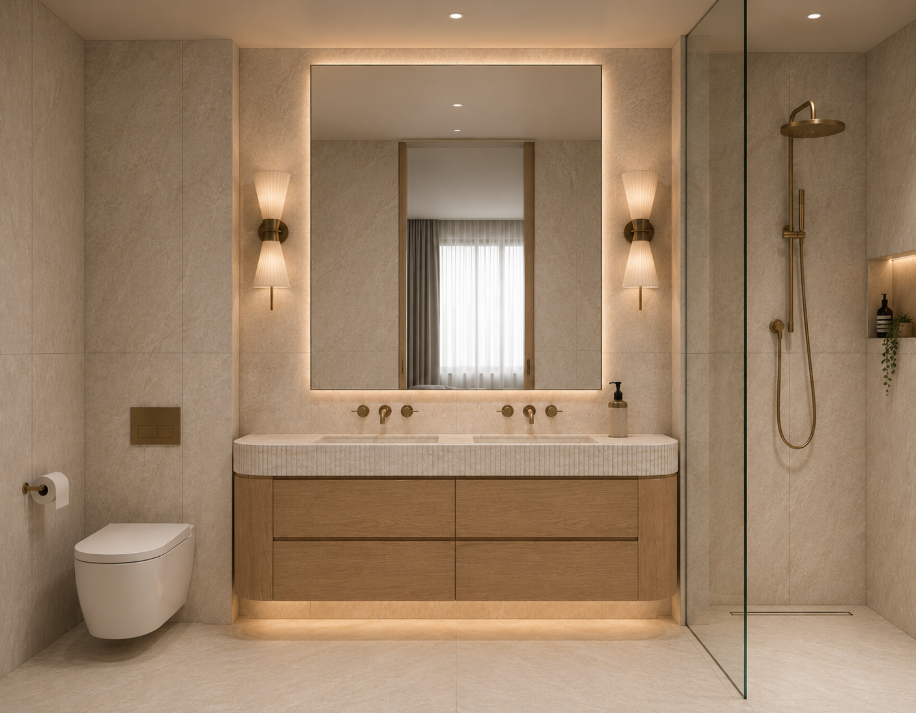
Every year around this time, we start fielding a particular kind of brief conversation: homeowners who've spent the summer break scrolling renovation inspiration and arrive with a folder of images that, on the surface, look wildly different but share a clear thread underneath. For 2027, that thread is warmth and texture — bathrooms that feel considered and tactile rather than simply clean and white.
Here's what's actually shaping bathroom renovation trends across Melbourne as briefs come in for the year ahead.
Curved vanities and softer joinery lines
The hard-edged, minimalist vanity that dominated bathroom design for the better part of a decade is softening. Curved fronts, rounded corners on benchtops, and gently bullnosed edges are showing up across nearly every 2027 bathroom brief we're seeing, replacing the sharp rectilinear joinery that felt inevitable a few years ago.
It's not purely aesthetic. Curves change how a small space feels to move through — a rounded vanity corner in a tight ensuite is genuinely easier to navigate than a square one, and the softness reads as more considered even in bathrooms with fairly restrained material palettes. Fluted and reeded timber fronts pair naturally with this shift, adding texture and vertical rhythm without needing a curved form at all, which makes the trend accessible even on tighter joinery budgets.
The common thread across this year's briefs is joinery that feels sculptural rather than purely functional — a vanity as a piece of furniture, not just storage with a basin on top.
Natural and engineered stone beyond the benchtop
Stone has been a bathroom staple for years, but where it's being used has shifted. Rather than confining a striking veined stone to the vanity top, 2027 briefs are pushing it onto walls, shower niches, and even full shower surrounds — a natural stone bathroom treatment that turns the material into the room's dominant feature rather than an accent.
Engineered stone continues to do a lot of this work practically, offering the visual drama of natural marble with more predictable performance in a wet environment. But there's a growing appetite for genuine natural stone too, particularly in main bathrooms and ensuites where owners are willing to invest in a single striking slab — bookmatched veining across a shower wall, for instance — as the room's hero moment, with everything else in the space kept deliberately quiet around it.
This "one hero material, everything else restrained" approach is worth noting for anyone assembling a luxury bathroom design brief on a realistic budget — it delivers the visual impact of an all-stone room without the full-room stone spend.
Sensory details: lighting, texture and warmth underfoot
If curves and stone are the visible trends, lighting and texture are the ones that actually determine how a bathroom feels to use every day.
Layered lighting has moved well beyond a single downlight and a vanity strip. 2027 briefs are increasingly specifying warm, dimmable lighting zoned separately for task use (shaving, make-up) and ambient use (an evening bath), often with a distinct, softer wash of light for shower niches and floor-level toe-kicks. The effect is a bathroom that can shift mood through the day rather than being lit the same way at 7am and 9pm.
Underfoot, heated flooring has gone from a luxury add-on to something close to a default expectation in the main bathroom and ensuite briefs, particularly in Melbourne's colder months. Paired with textured, matte-finish tiles rather than high-gloss options, the combination genuinely changes how a bathroom feels to stand in, not just how it looks in a photo. Textured plaster finishes and lime-wash-style paint on feature walls are showing up more often too, adding a tactile softness that tiled surfaces alone can't achieve.
Small bathroom trends vs main bathroom and ensuite trends
Not every trend translates evenly across bathroom sizes, and one of the more useful conversations in a brief is separating what works in a compact powder room or small ensuite from what needs the scale of a main bathroom.
In smaller spaces, the priority is usually a single, well-chosen material moment — a feature stone splashback, a curved vanity as the room's one sculptural element — paired with restraint everywhere else, since a small room can't absorb multiple competing statements the way a larger one can. Wall-hung vanities and recessed niches also do more work in compact bathrooms, since they preserve visual floor space that a floor-mounted unit would eat into.
Main bathrooms and ensuites, with more square metreage to work with, can support layered materials and features that would overwhelm a smaller room: a full stone shower wall alongside a curved freestanding bath, zoned lighting across multiple areas, and joinery that runs the full length of a wall. The trends are the same across both — it's the dosage that changes.
Frequently asked questions
Are freestanding baths still trending in 2027?
Yes, particularly in main bathrooms and ensuites with the floor space to accommodate one comfortably. The main shift is in form — softer, more sculptural silhouettes are more common in current briefs than the sharper geometric baths that were popular a few years ago.
What's the most cost-effective bathroom trend to adopt?
Layered, warm lighting is one of the more cost-effective changes available, since it can transform how a bathroom feels without touching tiling, joinery or plumbing. Textured matte tiles in place of gloss finishes are a similarly accessible way to bring in the tactile quality that's driving most 2027 briefs.
How long does a bathroom renovation take in Melbourne?
A standard bathroom renovation typically takes six to ten weeks on site once design and approvals are complete, though this can extend for main bathrooms with structural changes or where natural stone is being sourced and fabricated to order.
What should I know about waterproofing and ventilation in a 2027 bathroom brief?
Waterproofing standards haven't changed with the aesthetic trends, and they remain the single most important — if least visible — part of any bathroom renovation. Adequate exhaust ventilation, sized correctly for the room, also matters more as bathrooms trend toward heated flooring and more elaborate lighting, since good ventilation protects both the tactile finishes and the waterproofing membrane underneath them over time.
If you're planning a bathroom renovation and want to talk through which 2027 trends suit your space and budget, book a consultation with our team.
Formery Architecture + Interior Design is a Melbourne Architecture studio working across residential renovation, new builds, subdivision and dual occupancy projects. Our director Emma works with homeowners across Melbourne's inner north, inner south-east and bayside suburbs.
Book a free discovery call —formery.com.au